









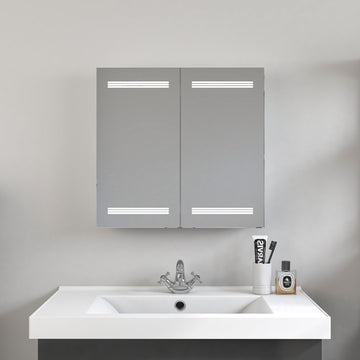
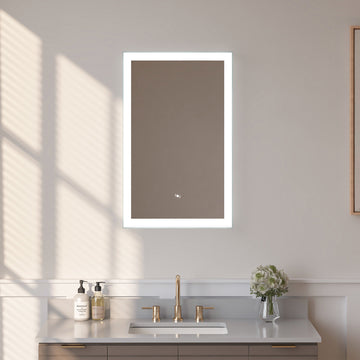
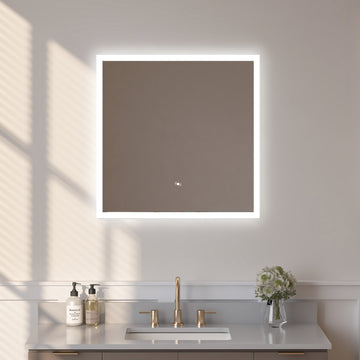
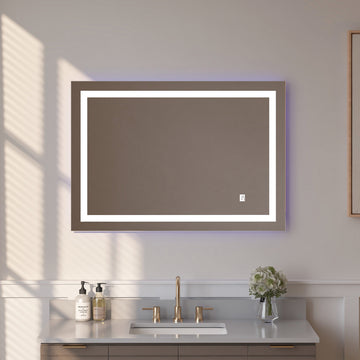

Picking an LED mirror that looks off-center, too small above a wide vanity, or mounted so high you can barely see your face is a frustrating and expensive mistake. This LED bathroom mirror size guide walks you through the exact measurements, ratios, and mounting heights that US homeowners need to get the look—and the function—right the first time. Whether you're doing a full remodel or just swapping out an old mirror, these guidelines apply to virtually every bathroom layout.
Why Size Matters More Than Style
An LED mirror can have the most attractive frame and the brightest lighting on the market, but if the proportions are wrong, the entire vanity wall will feel unbalanced. Size affects:
- Lighting coverage — A mirror that's too narrow concentrates light in the center and leaves the sides of your face in shadow.
- Visual balance — A mirror that's too wide makes a single-sink vanity look cluttered and awkward.
- Usability — Mounting height directly determines whether the mirror is actually useful for everyone in the household.
Getting these three things right costs nothing extra. It just requires a tape measure and a few minutes of planning before you order.
The Mirror-to-Vanity Width Ratio Rule
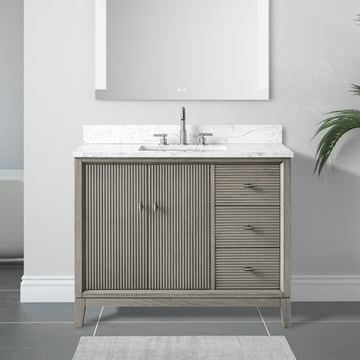
The single most reliable rule for sizing a bathroom mirror is to match it to the width of your vanity. The general guideline used by most designers and contractors in the US is:
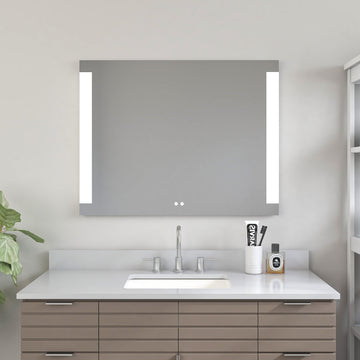
- Your mirror should be 2 to 4 inches narrower than your vanity on each side, meaning the total mirror width is roughly 4 to 8 inches less than the vanity width.
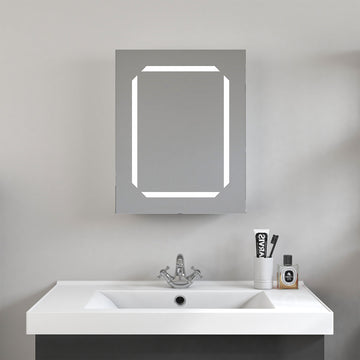
- For a 36-inch single-sink vanity, choose a mirror between 28 and 34 inches wide.
- For a 48-inch vanity, aim for a mirror between 40 and 46 inches wide.
- For a 60-inch double-sink vanity, a mirror between 52 and 58 inches wide works well — or consider two separate mirrors centered over each sink.
- For a 72-inch double vanity, go with a mirror between 64 and 70 inches wide, or two individual mirrors in the 28–32 inch range.
The reason for keeping the mirror narrower than the vanity is visual grounding. When the mirror extends to or beyond the vanity edges, the eye has no clear stopping point and the wall feels unanchored. Keeping it slightly inset creates a clean, intentional frame.
If you're shopping for a new vanity at the same time, browse the Vanities collection to find widths that pair naturally with standard LED mirror sizes.
Single Sink vs. Double Sink: Different Approaches
For single-sink vanities, one centered mirror is almost always the right choice. The mirror-to-vanity ratio above handles the width question, and you're done.
For double-sink vanities, you have two options:
- One large mirror spanning most of the vanity width — practical, easy to install, and works well in smaller bathrooms where two mirrors would feel crowded.
- Two individual mirrors, each centered over its respective sink — this approach offers a more custom, high-end look and makes it easier for two people to use the vanity simultaneously without competing for mirror space.
If you go with two mirrors on a double vanity, treat each sink as its own 30–36 inch zone and size each mirror accordingly. The gap between the two mirrors should be at least 4 to 6 inches so they don't visually merge into one awkward shape.
The Double Sink Vanity and Single Sink Vanity collections can help you confirm your vanity dimensions before finalizing your mirror order.
Mirror Height: How Tall Should Your LED Mirror Be?
Width gets most of the attention, but height matters just as much for daily usability. A few practical guidelines:
- For most bathrooms, a mirror height of 28 to 42 inches works for the widest range of household members.
- Taller mirrors (36–42 inches) are a good choice when the vanity counter is lower, or when the bathroom has high ceilings that would leave a short mirror looking lost on the wall.
- If ceiling height is 8 feet or more, you can go taller without the mirror feeling overwhelming — some homeowners use mirrors up to 48 inches tall in large master bathrooms.
- For smaller half-baths or powder rooms, a mirror in the 24–30 inch height range is usually proportionate.
Mounting Height: Where Should the Mirror Sit on the Wall?
This is where a lot of DIY installs go wrong. The standard recommendation is:
- Mount the mirror so the bottom edge sits 5 to 10 inches above the top of the faucet or the backsplash, whichever is higher. This prevents water splash damage and gives the vanity room to breathe visually.
- The center of the mirror should be at eye level for the primary user, which in most US homes falls between 57 and 65 inches from the finished floor. For households with significant height variation, aim for 60 inches as a neutral midpoint.
- In bathrooms used by children, you may want to mount slightly lower — 54 to 57 inches to center — and compensate with a taller mirror so adults are still covered.
LED mirrors with adjustable color temperature and brightness (typically 3000K–6500K) are especially forgiving of mounting position because they produce even, diffused light rather than a single overhead point source. Still, getting the height right is worth the effort.
Shape Considerations: Rectangle, Round, or Oval?
Shape is partly aesthetic, but it has practical sizing implications:
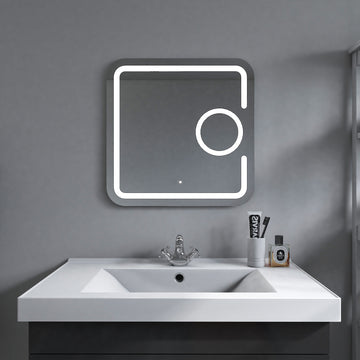
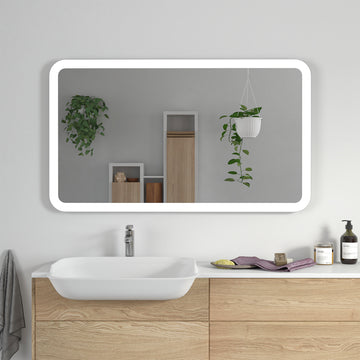
- Rectangular mirrors are the most versatile and easiest to size against a vanity using the width ratios above. They maximize usable reflection area for the frame footprint.
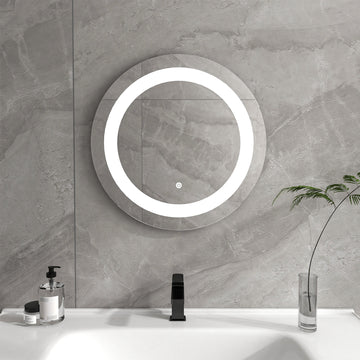
- Round mirrors are measured by diameter. A 30-inch round mirror over a 36-inch vanity works well, but a 24-inch round mirror on the same vanity can look undersized. As a rule, the diameter should be at least 70% of the vanity width.
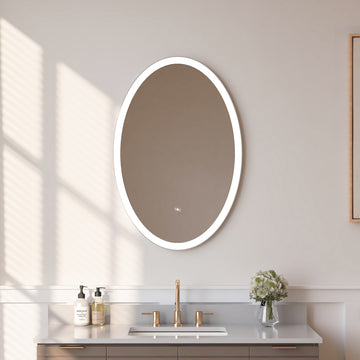
- Oval mirrors split the difference — they're friendly in bathrooms with curved architectural details and can read slightly larger than their actual dimensions because of the flowing outline.
Explore the full LED Mirror collection to compare shapes and dimensions side by side.
Clearance, Outlets, and Practical Installation Notes
Before you finalize your size, check the wall for a few potential obstacles:
- Electrical outlets — Most LED mirrors are hardwired or plug-in. Confirm the outlet location won't land behind the mirror.
- Side walls and cabinets — Leave at least 2–3 inches of clearance between the mirror edge and any adjacent wall or medicine cabinet to avoid a cramped look.
- Sconce lighting — If you plan to add wall sconces on either side of the mirror, account for their width in your mirror sizing. In this configuration, a slightly narrower mirror (6–10 inches less than vanity width instead of 4–8) often reads better.
- Weight — Larger LED mirrors can weigh 20–40 lbs. Make sure you're mounting into studs or using appropriate drywall anchors rated for the load.
Quick Reference: Mirror Size by Vanity Width
- 24-inch vanity: Mirror 18–22 inches wide, 24–30 inches tall
- 30-inch vanity: Mirror 24–28 inches wide, 28–36 inches tall
- 36-inch vanity: Mirror 28–34 inches wide, 28–36 inches tall
- 48-inch vanity: Mirror 40–46 inches wide, 30–40 inches tall
- 60-inch vanity: Single mirror 52–58 inches, or two mirrors at 24–28 inches each
- 72-inch vanity: Single mirror 64–70 inches, or two mirrors at 28–32 inches each
Frequently Asked Questions
Can my LED mirror be the same width as my vanity?
Technically yes, but it's not recommended. When the mirror matches the vanity width exactly, the two elements compete visually rather than one framing the other. Keeping the mirror 4 to 8 inches narrower creates the layered, intentional look most designers aim for. If you're working with a very narrow vanity (24 inches or less), you can close that gap to 2–4 inches total.
How high above the vanity should an LED mirror be mounted?
Mount the bottom edge of the mirror 5 to 10 inches above the top of the faucet or backsplash. Then confirm the center of the mirror lands between 57 and 65 inches from the floor. If those two targets conflict, prioritize the eye-level guideline and adjust the gap above the faucet as needed — as long as you clear the plumbing fixtures by at least 5 inches.
Does the LED mirror size affect lighting quality?
Yes, in a practical sense. A mirror sized correctly for the vanity will distribute its built-in LED lighting evenly across your face from both sides. A mirror that's too narrow concentrates light in the center, creating harsh contrast at the edges. A mirror that's too wide spreads light beyond where you're standing, reducing perceived brightness. Proper sizing and LED technology work together — neither one compensates for the other.
Ready to find the right fit for your space? Browse the complete Mirrors collection at VanityArt to shop by size, shape, and style — and pair your new mirror with a vanity that matches your bathroom's dimensions exactly.